
Why Fueling Matters for Endurance Athletes
When you’re out on the prairie for hours—whether it’s the Iron Horse Trail, climbing steep mountains, or a long solo day in the foothills—your body can only absorb so many carbohydrates at once. Use our handy calculator as a starting point or continue reading and make your own calculations! For years, people thought the limit was 60 g/hour. Then researchers discovered something big:
Two Transporters = More Fuel
Your gut uses:
SGLT1 to absorb glucose
GLUT5 to absorb fructose
Use both at the same time, and suddenly you can absorb more than 60 g/h—sometimes much more.
This is why modern endurance fueling mixes blend glucose (or maltodextrin) with fructose.
What the Researchers Have Recently Discovered
Key Discoveries
Combining glucose + fructose boosts absorption and oxidation by ~50% compared to glucose alone.
Athletes can sometimes use up to ~120 g/h efficiently, but 90 g/h is the most reliably tolerated amount for most people.
The “optimal” ratio depends on how much you’re taking in—not a fixed number.
So… What Ratio Should You Use?
There is no single optimal ratio. Instead, match the ratio to your target hourly intake.
General Guidelines
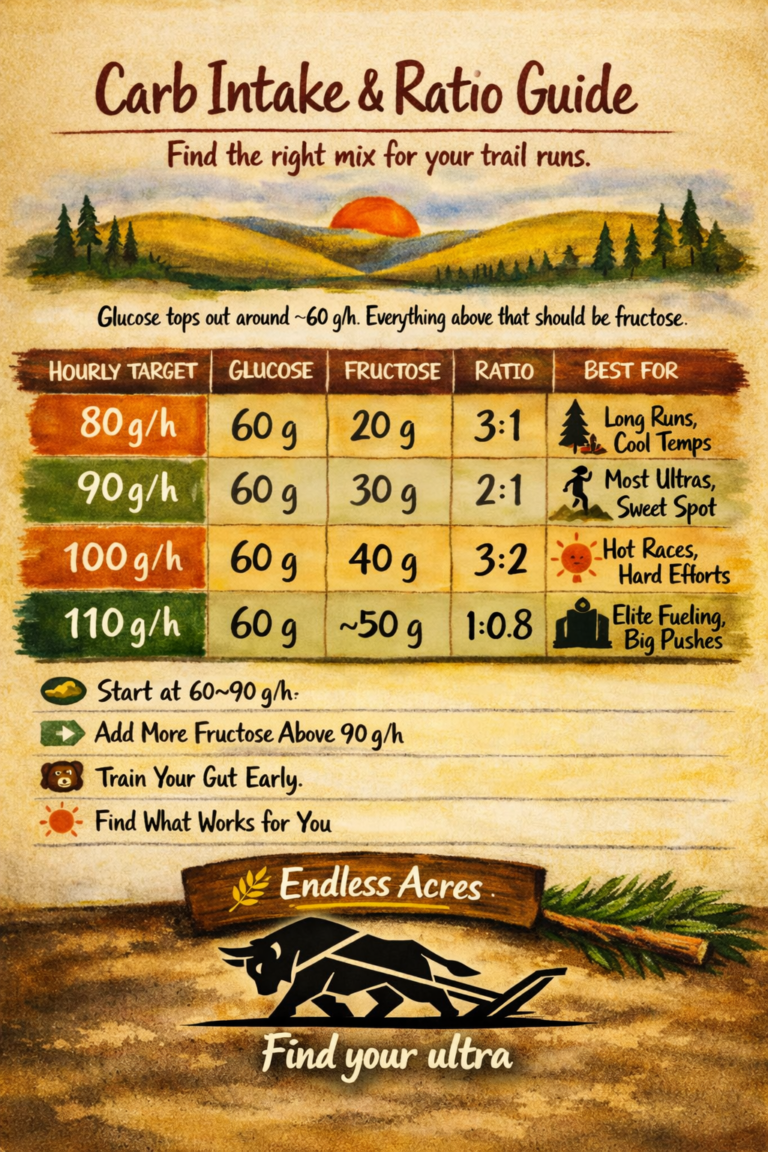
Why glucose stays around 60–70 g/h
That’s roughly the max your glucose transporter can handle. Everything above that should come from fructose.
What About Commercial Mixes?
Most brands use:
-
2:1 glucose : fructose (great for ~90 g/h)
-
1:0.8 glucose : fructose (better for 100–110 g/h)
What About Homemade Mixes?
Make your own with table sugar (Sucrose):
-
1:1 glucose : fructose (great for saving money on training runs)
But again—your gut is the boss.
Practical Takeaways for Alberta Trail Runners
1. Train your gut
Just like hill repeats, your stomach adapts. Practice your race-day intake on long runs.
2. Start with 60–90 g/h
This is the sweet spot for most runners without GI blowback.
3. Adjust based on tolerance
If you’re pushing elite-level efforts or long ultras like Lost Soul or Blackfoot, you might benefit from 100+ g/h—but only if your gut can handle it.
4. Don’t chase the “perfect ratio”
Chase what you can absorb comfortably.
5. Make your own
Reduce the financial burden and make your own at home!
Source 2: https://www.mysportscience.com/post/the-optimal-ratio-of-carbohydrates