
Most runners think carb loading is a big bowl of pasta the night before a race. Cute idea unfortunately totally wrong. Use our Calculator to get you specific numbers!
The science says your muscles need 36 to 72 hours of high‑carb eating to fully saturate glycogen stores. That’s your long‑range fuel tank, and it’s what keeps you moving when the miles get dark and the prairie wind starts asking questions.
The Science‑Backed Numbers
To actually carb load, you need:
8–12 grams of carbs per kilogram of bodyweight per day
for 1–4 days before your race.
For a 155 lbs. runner, that’s:
560–840 g of carbs per day
Yes, per day
Yes, it feels unhinged
Yes, it works
This is the part of the study most people skip because the numbers look ridiculous. But this is how you show up on race morning with your glycogen tank topped off and ready to roll.
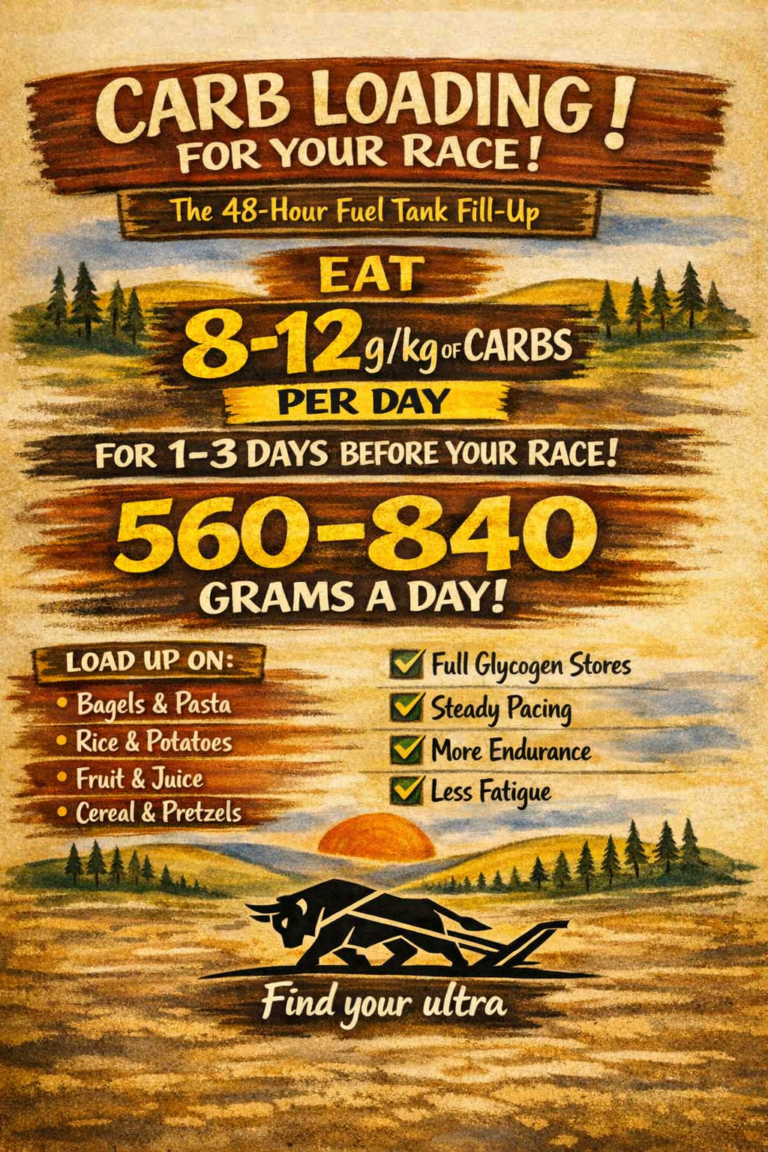
Why It Works
Your muscles can store a lot of glycogen — but only if you give them enough raw material. When glycogen is full, you get:
steadier pacing
stronger late‑race legs
fewer bonk moments
better power output
more mental clarity
It’s like starting a road trip with a full tank instead of hoping the gas light doesn’t come on before the next town.
What Carb Loading Actually Looks Like
This isn’t “eat a big dinner.” This is “eat carbs all day long.”
Think:
bagels (48-56g per serving)
pancakes (20-30g per serving)
rice bowls (40 per cup white, 56 per cup brown)
potatoes (27-40g per serving)
fruit juice (30g per cup)
cereal (25-30g per cup)
sports drinks (21g per 12oz)
honey (17g per Tbsp)
bananas (17g per fruit)
Simple, fast‑digesting carbs. Low fiber. Low fat. Keep the engine clean.
Key Takeaway
Carb loading isn’t a vibe, its really not fun, it’s a protocol.
If you want to toe the line with your glycogen tank full, the science is clear:
- Eat 8–12 g/kg/day of carbs for 36 to 72 hours before your race.
- Don’t rely on one big meal.
- Don’t be scared of the numbers — they’re supposed to look huge.
This is how you start your race already fueled, already strong, already ready to find your ultra.